A Practical Guide to Balancing Growth, Reinvestment, and Withdrawals
Reading Time: 8–10 Minutes
Overview
Once you understand how the WinVest investment plan works, another question naturally comes up:
“What should I do over the long term?”
Should you reinvest everything?
Should you start taking withdrawals?
Should you try to recover the money you originally put into WinVest?
Or should you do a combination of all three?
There is no single strategy that is right for everyone.
Your approach should depend on your goals, how much you originally invested, how much you are comfortable having invested, and how much risk you are willing to accept.
This guide will help you think through those decisions and develop a strategy that makes sense for you.
IMPORTANT: This article is for educational and planning purposes only. It is not financial advice and does not recommend a particular investment or withdrawal strategy. Cryptocurrency-related investments involve risk. Never invest money you cannot afford to lose.
Start With How the 60-Day Plan Works
Before developing a strategy, there are several important things to remember about the current WinVest plan.
WinVest currently describes its plan as paying 3% daily for 60 calendar days. Each additional deposit or reinvestment is treated as a separate investment with its own 60-day term.
This becomes especially important when you reinvest frequently.
For example, suppose you make:
- An original investment on July 1
- A reinvestment on July 2
- Another reinvestment on July 3
- Another on July 4
You don’t have one investment ending on the same day.
You now have multiple investments with different starting and ending dates.
As time passes, older investments will complete their 60-day cycles while newer investments continue earning.
That is why a long-term strategy isn’t simply about accumulating the largest possible number.
It’s about deciding how you want to manage the money flowing through your account.
Think of Your Strategy in Three Stages
One simple way to approach long-term planning is to divide it into three stages:
Stage 1 — Build
Use more of your available earnings for reinvestment.
Stage 2 — Recover
Begin taking withdrawals with the goal of recovering some or all of your original out-of-pocket contribution.
Stage 3 — Balance
Decide how much of your available earnings you want to withdraw and how much you want to continue reinvesting.
You don’t have to follow these stages exactly.
They are simply a framework that can make planning easier.
Stage 1: Building Your Active Investments
Many people begin by concentrating on growth.
Instead of withdrawing their available earnings, they reinvest some or all of them.
WinVest currently allows earnings in the Available Balance to be manually reinvested once the investment minimum is met. Each reinvestment then starts a new 60-day investment cycle.
This is what creates the compounding effect.
Example
Suppose you have $12 available.
You could:
Withdraw the $12
or
Reinvest the $12
If you reinvest it, that $12 becomes another active investment with its own 60-day earning period.
Continue doing this over time and you may build many individual active investments.
The advantage
More money remains working within your investment strategy.
The trade-off
You aren’t actually taking those funds out of WinVest.
This distinction is important.
Account growth and money actually withdrawn to your own wallet are not the same thing.
Stage 2: Recovering Your Original Contribution
At some point, you may decide that you don’t want to reinvest everything.
One possible goal is to begin recovering the amount of money you originally contributed from outside WinVest.
Suppose you originally funded your account with:
$500
After building the account for a period of time, you might begin making withdrawals.
If your cumulative withdrawals eventually reach $500, you could personally consider that you have recovered an amount equal to your original out-of-pocket contribution.
Important distinction
This does not mean WinVest returns your original $500 to you as a lump sum.
Under the current plan, the original principal is not separately returned at Day 60. WinVest says it is included as part of the daily credits received throughout the 60-day term.
Recovering your original contribution is therefore a personal planning goal, not a special feature of the WinVest plan.
For some investors, reaching that point may change how they feel about their overall strategy.
Stage 3: Finding a Balance Between Growth and Income
Eventually, you may decide you don’t want to choose between:
Reinvest everything
and
Withdraw everything
There is a third option:
Do some of both.
For example, when money becomes available you could choose to:
- Reinvest a portion
- Withdraw a portion
This can allow you to continue creating new investments while also moving some money out of WinVest and into your personal cryptocurrency wallet.
This is where a long-term strategy becomes very individual.
Three Example Strategies
The following are examples only. They are not recommendations.
Strategy 1 — Growth Focused
Someone primarily interested in building their account might choose to reinvest most of their available earnings.
An example might be:
75% Reinvest
25% Withdraw
Or, during an initial growth period, the person might choose to reinvest 100%.
Goal:
Build active investments more quickly.
Consideration:
Less money is being removed from the platform.
Strategy 2 — Balanced
Someone who wants both growth and withdrawals might use a more balanced approach.
For example:
50% Reinvest
50% Withdraw
If $100 becomes available:
- $50 could be reinvested
- $50 could be withdrawn
Goal:
Continue creating new investments while regularly taking some money out.
This approach may appeal to someone who wants to see both account growth and actual withdrawals.
Strategy 3 — Income Focused
Someone who has already built a larger base of investments may decide that taking income is now more important than maximizing growth.
For example:
25% Reinvest
75% Withdraw
Goal:
Move a larger percentage of available earnings into your personal wallet while continuing some reinvestment.
Again, there is nothing special about 25%, 50%, or 75%.
They simply make the different approaches easier to understand.
You Can Change Strategies
Your strategy does not have to remain the same forever.
This is one of the most important concepts in this guide.
You might begin with:
100% Reinvestment
Then move to:
75% Reinvestment / 25% Withdrawal
Later:
50% Reinvestment / 50% Withdrawal
And eventually:
25% Reinvestment / 75% Withdrawal
Or you might choose something completely different.
Your strategy can change as your goals and circumstances change.
Don’t Forget About Expiring Investments
This is an important part of long-term planning.
Every individual investment has its own 60-day cycle.
Eventually, your earlier investments begin reaching the end of their cycles.
When an investment reaches Day 60, its daily earnings stop. WinVest says any earnings remaining in your Available Balance can then be withdrawn or reinvested under the normal rules.
Meanwhile, newer investments and reinvestments may still be active.
This creates a constantly changing group of investments.
Think of it as a series of overlapping 60-day cycles rather than one giant investment.
That is why continuing to reinvest some earnings can create new investments as older ones complete their cycles.
Watch Your Active Investments
Your WinVest dashboard provides an Active Investments figure.
This is different from Total Investments.
Active Investments
The amount currently represented by investments that are still active.
Total Investments
The cumulative amount you have invested and reinvested over time.
Your Active Investments figure can change as investments are added and older investments complete their cycles.
When planning your strategy, Active Investments is therefore one of the numbers worth watching.
Your Available Balance Is Another Important Number
Your Available Balance helps you decide what to do next.
WinVest currently permits withdrawals once the Available Balance reaches its minimum withdrawal requirement, and available funds can also be used for reinvestment once the investment minimum is met.
That creates a simple decision:
When money becomes available, what do I want it to do?
Withdraw it?
Reinvest it?
Or split it between the two?
That decision is at the heart of your long-term strategy.
Don’t Confuse Account Value With Money You’ve Received
This deserves special attention.
Seeing larger numbers inside an investment account can be exciting.
But there is an important difference between:
Money displayed inside your WinVest account
and
Bitcoin you’ve successfully withdrawn to a wallet you control.
When evaluating how your strategy is performing, consider tracking both.
For example:
| Item | Amount |
|---|---|
| Original Out-of-Pocket Contribution | $500 |
| Total Withdrawn to Personal Wallet | $325 |
| Amount Remaining to Recover Original Contribution | $175 |
Once withdrawals total $500 in this example, the person has withdrawn an amount equal to the original $500 contribution.
Anything beyond that could then be viewed differently when evaluating the results of the strategy.
Don’t Assume Today’s Plan Will Continue Forever
This may be the most important long-term planning principle.
A projection is not a prediction.
You can calculate what might happen if the current plan continues unchanged, but that doesn’t mean it will.
Investment terms can change. Companies can change plans. Cryptocurrency markets can change. Withdrawals can be affected by operational or market conditions.
Therefore, don’t build a personal financial plan that depends upon a particular return continuing indefinitely.
The current WinVest terms should be treated as the current terms, not a promise about what will be available months or years into the future.
A Simple Long-Term Planning Exercise
Ask yourself these five questions:
1. What is my primary goal?
Growth, income, recovering my original contribution—or some combination?
2. How much have I personally contributed?
Separate outside money you’ve deposited from money generated inside the account.
3. How much have I actually withdrawn?
Track money that has successfully reached your personal wallet.
4. How much do I want to continue reinvesting?
You don’t have to reinvest everything.
5. At what point would I change strategies?
Decide ahead of time what might cause you to shift from growth toward withdrawals.
Writing these answers down can make your strategy much clearer.
Example of a Complete Strategy
Here is a hypothetical example.
Mary starts with $500.
Phase 1 — Build
Mary initially chooses to reinvest most of her available earnings.
Her goal is to create additional active investments.
Phase 2 — Recover
After reaching a level she’s comfortable with, Mary begins withdrawing part of her available earnings.
She keeps track of those withdrawals.
Her goal is eventually to withdraw a total of $500, equal to her original out-of-pocket contribution.
Phase 3 — Balance
After reaching that goal, Mary decides to split future available earnings between withdrawals and reinvestments.
She periodically reviews her Active Investments and adjusts the percentages based on her goals.
Mary isn’t assuming WinVest will continue indefinitely.
She’s simply making decisions based upon the account and plan that exist at that time.
The Goal Is a Plan — Not a Prediction
A long-term strategy doesn’t tell you what WinVest will do.
It tells you what you intend to do under different circumstances.
That’s an important difference.
Instead of asking:
“How much money will I have a year from now?”
Consider asking:
“What will I do with the money that becomes available along the way?”
That’s a question you can actually control.
Key Takeaways
- Every investment and reinvestment has its own 60-day cycle.
- Reinvesting can create additional active investments.
- You do not have to reinvest everything.
- Available funds can be divided between withdrawals and reinvestment.
- One possible goal is withdrawing an amount equal to your original out-of-pocket contribution.
- Track actual withdrawals separately from numbers displayed inside the account.
- Older investments eventually complete their cycles while newer ones may continue.
- Your strategy can change as your goals change.
- Never assume today’s investment terms or returns will continue indefinitely.
- Never invest money you cannot afford to lose.
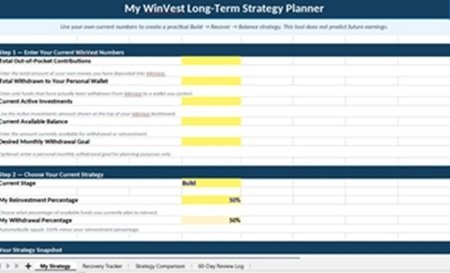
My WinVest Long-Term Strategy Planner
Build Your Personal Plan for Growth, Reinvestment & Withdrawals
This worksheet is designed to help you think through your own WinVest strategy and plan out your goals.
Related Articles
How Compounding Works with Different Starting Amounts
See how different starting amounts can affect the pace of compounding.
Reinvesting Your Earnings & Account Balance
Learn how manual reinvestment works and why every reinvestment creates a separate investment cycle.
Understanding the Investment Plan
Review the fundamentals of WinVest’s 60-day investment structure.
Learn how Available Balance and withdrawals work.
Learn the difference between Active Investments, Total Investments, Account Balance, Total Earnings, and other important figures.
Final Thought
There isn’t one perfect WinVest strategy.
Someone focused on growth may make different choices from someone who wants regular withdrawals. And someone who has already recovered an amount equal to their original contribution may approach the account differently from someone just getting started.
The purpose of a strategy is to give yourself a framework:
Build → Recover → Balance
Then review your results periodically and adjust your decisions as circumstances change.
For the official current plan terms, policies, and withdrawal requirements, always refer to WinVest’s official website.